


By Jacqui Fatka, Biofuels Economist, CoBank
 Heading into 2026, ethanol refineries will benefit most from the extension of the Clean Fuel Production Credit known as 45Z, however, sustainable aviation fuel (SAF) will continue to struggle to get takeoff. Changes made in the One Big Beautiful Bill Act preserved 45Z but equalized the previously higher benefit of SAF with that of on-road fuels.
The 45Z tax credit can be transferred to other obligated parties, allowing facilities to sell those credits and guaranteeing income throughout the year. The incentive structure primarily benefits facilities that can monetize the credits by reducing their overall carbon intensity scores. A typical ethanol plant producing 100 million gallons annually can receive a credit of 10 to 20 cents per gallon, with higher credits for facilities that capture and store CO2.
Although 45Z presents new opportunities for ethanol producers and other biofuel facilities to capture significant tax credits, it may limit direct profit potential for farmers. Unless biofuel producers are willing to pay premiums for lower carbon intensity feedstocks, farmers may not see substantial financial gains from the 45Z program.
The recent modification eliminating the 75 cents per gallon SAF production extra incentive has significantly reduced the enticement for domestic investment in new or expanded SAF facilities. Without these targeted domestic incentives, SAF produced within the U.S. may increasingly be exported to meet rising SAF mandates in the United Kingdom and European Union markets.
Many renewable diesel facilities in the U.S. can toggle between producing renewable diesel (RD) and SAF. The cost of producing SAF can be two to five times more than conventional diesel, creating an economic incentive to run RD rather than SAF at these plants. The economic realities with the lower tax credits exacerbate the existing mismatch between the available supply of SAF and the demand from aviation carriers. Meanwhile, very little alcohol-to-jet SAF is produced today due to higher costs.
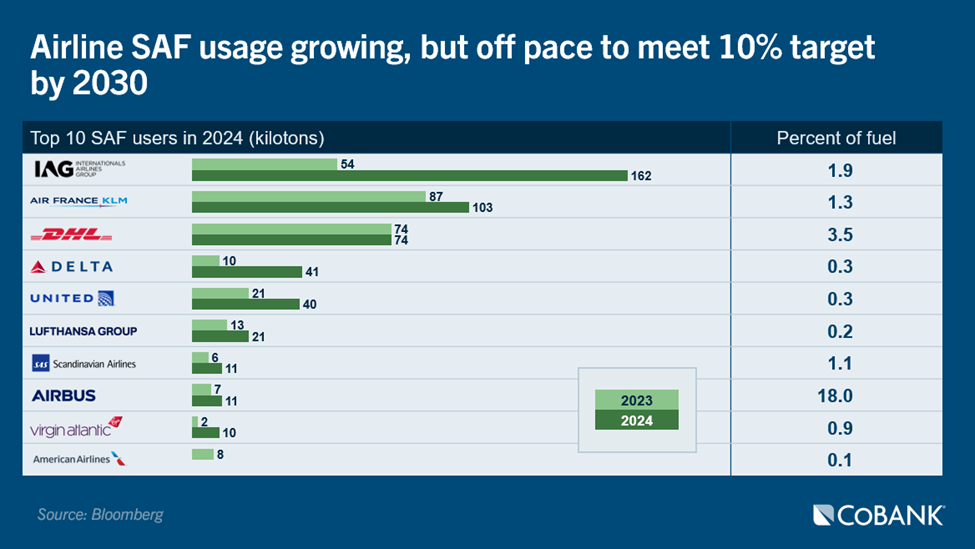
According to a report from Carbon Tracker, even if all current and announced SAF projects are completed, global output would satisfy only 5% of total jet fuel demand by 2030. This production level would offset just 17% to 30% of the expected demand growth in the aviation sector. Worldwide SAF production today amounts to a mere week’s worth of total airline fuel use. The International Air Transport Association reported SAF production in 2025 represents only 0.6% of total jet fuel consumption and is projected to tick up to 0.8% in 2026, illustrating that meeting the SAF target is unlikely. The current trajectory falls significantly below what is needed to reach the global airline industry's target of reaching 10% by 2030.