




Ethanol producers face new requirements
By Susanne Retka Schill
Another record marketing year for ethanol exports closed the books this fall, with confident expectations the trajectory will continue based on carbon reduction goals and a renewed understanding of the need for energy security and diversification.
“We are starting to see more and more countries that are interested in adopting ethanol or increasing their blend volumes because some of the other technology options that reduce carbon are not coming online as quickly as people were anticipating,” says Alicia Koch, director of global ethanol export development, US Grains & BioProducts Council (USGBC). “They really need a solution that's available today, and ethanol fits that goal perfectly.”
“But the other piece of that is very much due to the global instability that we've seen and supply chain disruptions,” she continues. “And it hasn't been just this most recent conflict, but also the war in Ukraine. People are realizing that maybe these are not isolated incidents. And so being able to have energy security and energy diversity is becoming more and more important. I think we certainly saw the urgency of finding other options this spring. That has also increased the interest in ethanol.”
Ethanol exports for the marketing year ending August 31 were up 10% from the previous year, totaling 2.38 billion gallons. Canada ranks as the number one buyer at 890 million gallons, up 12.5% from last year, with the EU and UK coming in second and third.
Export volumes have doubled in the past five years, says Hagan Rose, vice-president of global trade with Eco-Energy, and now absorb between 12 and 15% of total U.S. production. “In a world with a lot of uncertainty, the one constant over the last five years is continued growth in U.S. exports. We’re fortunate that in a very volatile energy market, we’ve had a reasonably consistent value in the world as well as in the United States.”
Top Export Destinations
Receiving more than a third of ethanol exports last year and this, Canada is by far the U.S. industry’s most important customer. “We have still seen sustained trade with that market, despite some of the tensions,” Koch says. “I think that is because Canada has done such a good job of implementing higher blends. They've really made sure that their policy and their regulations support the ability to roll out higher blend volumes without a lot of barriers.” Canada is well ahead in meeting their 2030 blending goals in multiple provinces, she adds, “and that’s directly contributing to a lower price at the pump for their consumers and meeting their carbon obligations.”
Rose adds that even with a couple of provinces instituting made-in-Canada policies, “the growing blend in Canada has been able to support U.S. imports, and frankly we have not seen demand destruction.”
The need to meet carbon reduction goals is behind increased shipments across the Atlantic. Exports to the EU and UK this year totaled a combined 661 million gallons, up from 532 million last year. Sorting out just how much went to the EU versus the UK is tricky, Koch explains, because much of the ethanol purchased by the UK was routed through the Rotterdam port and thus initially reported as exported to the EU. The trade deal with the UK totals 1.4 billion liters (870 million gallons), she adds. “We already filled 82% of that as of early October,” she says. “And will most likely fulfill that by the end of the year. Then we’ll work to align the U.S. export data with the UK import data.”
Developments in multiple countries point to continued growth in exports, Koch says. Japan’s carbon intensity requirement sets a 60% reduction compared to gasoline, plus they have a goal of reaching E10 by 2030 and E20 by 2040. The E10 goal alone amounts to a 1.2-billion-gallon demand. “It’s a very, very large market, and that’s just for on road,” she says, pointing to three alcohol-to-jet fuel projects in development in Japan, plus a growing interest in ethanol for maritime fuel.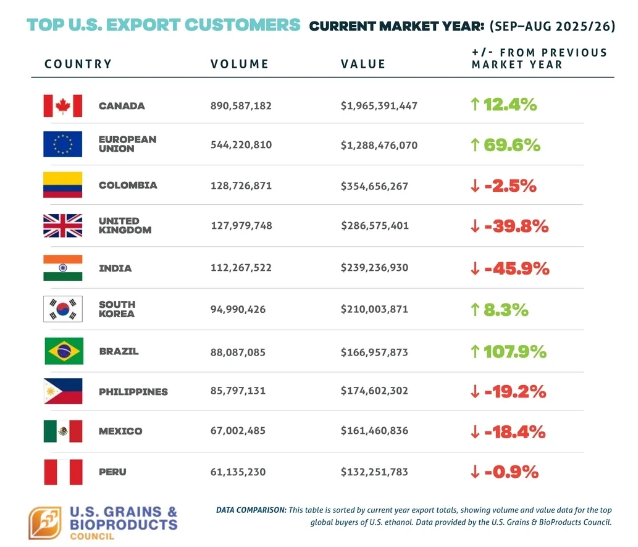
Though a relatively small country, Columbia has ranked as one of the top five destinations for U.S. ethanol in recent years because its carbon reduction goals are only partially met by their domestic sugarcane-based ethanol. Columbia may soon be joined by Guatemala, another cane-ethanol producer that implemented an E10 mandate this summer. “They are actually quite a large ethanol producer themselves, producing a very low carbon intensity ethanol,” Koch says. “They are able to export a lot of that to Europe for a premium. About 82% of their production goes to Europe, which leaves a gap the U.S. can help fill.” A trade agreement calls for about 50 million gallons, she adds, saying, “We anticipate that it could continue to grow.”
Brazil increased its purchases by 46 million gallons over last year. Political dynamics and economics helped boost those volumes compared to recent years, Koch explains, alongside the goals of Brazil’s low carbon fuel standard, Renova Bio. And, like Columbia and Guatemala, “They would be exporting their lowest carbon intensity alcohol because they’re getting a premium, but at the same time, they have such a huge domestic market,” she says. Brazil recently moved to E32 as its standard gasoline blend.
Using U.S. ethanol to supplement domestic production is behind growing Asian exports as well, Rose says, citing Vietnam and the Philippines. “With a new 10% blend in Vietnam, the U.S. is the primary supplier of imported material, supporting a local industry that produces ethanol from various grains and cassava. The Philippines began a blending program very early that engaged a local market and opened the opportunity to import.” Economics and a heightened focus on energy security have led to Vietnam outperforming blending projections and a new goal of a 20% blend in the Philippines.
Finding Freight
As the export market has grown, finding freight is the challenge, Rose says. “Canada is primarily a rail delivered market, but finding available marine freight to reach markets in Asia and Europe in a very dynamic freight world continues to provide challenges.” Historically, with the exception of rail deliveries to Canada and Mexico, exported ethanol moves down the Mississippi to the Gulf where Rose says marine logistics are superior to most markets for loading out liquid products. “The U.S. has kept up with demand over the last five years with the capacity we have. That has to grow, and we’re seeing that with new projects on the West Coast and the Gulf for landing unit trains of ethanol to load vessels.”
Fulfillment Challenges
The growing export demand also presents regulatory and compliance challenges. For one, international destinations often require different specifications. “One of the idiosyncrasies of global ethanol is variances in water content,” Rose says.
U.S. production specs call for 1% water by volume or about 1.25% by mass, he explains. “The primary specs being shipped today vary from 0.8% water down to as low as 0.25% water by mass.” Producers are meeting those specs with increasingly better efficiency, he adds, which oftentimes means adding dehydration capacity. “We’ve seen the producing side of the market be eager to make those investments to have the opportunity to reach the world market.”
“Compliance is another level of sophistication or complexity that adds to the equation,” Rose adds. “The two largest export markets for the U.S., Canada and Europe, including the UK, require a pretty specific sustainability program.”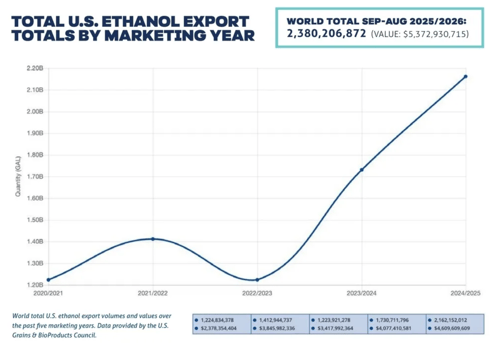
A good swath of the ethanol industry is getting a taste of those sustainability requirements, says Kari Buttenhoff, partner with Christianson PLLLP. California is adopting new requirements in a program getting closer to the EU’s sustainability program, the Renewable Energy Directive (RED). “There are three different steps that are going to take California to the full ISCC, which is one standard under EU RED,” she says. The standards set by International Sustainability and Carbon Certification program are being widely adopted in global markets alongside the EU RED.
Ethanol producers are getting a crash course as the first piece of California’s program impacts the 2026 crop year, Buttenhoff continues. Plants have to trace their feedstock back to the farm and gather shape files for documentation—a shape file being satellite imagery, or a map, showing the boundary of fields. Grain from several farms can be commingled, she adds, with a mass balance calculated to show that incoming bushels equals the outgoing or consumed bushels.
The next step in 2028 will require verification the land has been actively managed since 2008, she says. A couple of years later, California will ask for a full certification by approved certification schemes such as the EU RED or the ISCC. “It pulls in everything that ISCC would look at,” she says, which includes the land use change requirement, water use, and social and economic reviews throughout the supply chain. The regulations also require the supply chain to comply with all local, state and federal laws and regulations.
While Canada also has land use change requirements, our northern neighbor is relying on the U.S. EPA’s aggregate compliance policy. When the Renewable Fuel Standard (RFS) was implemented, EPA established an acreage baseline, Buttenhoff explains, “and if we ever exceed that, then the RFS will also go to tracking back to the field. So far, we are not in any danger of exceeding that aggregate compliance.”
Ethanol producers buying directly from farmers will likely find it easier to implement the new traceability requirements, although Buttenhoff adds some farmers have been somewhat reluctant. The real hole, she says, is with commercial grain handlers. “Commercial grain handlers have been slow to jump on board with all the traceability stuff. And unfortunately, there’s not a premium tied to it. It’s not going to lower the CI score, but it’s a requirement to maintain market share. If you don’t have feedstock with traceability, you can’t sell into California with your low CI.”
While plants shipping west grapple with the new requirements, all producers are evaluating whether they should begin collecting farm-level records to earn 45Z tax credits under USDA’s new regenerative agriculture rules. However, the sustainability requirements for California and some export markets are very different from the farm-level records needed for 45Z. The regenerative agriculture rules for 45Z are focused on farm practices, which are not part of the ISCC’s sustainability criteria.
Rose, however, thinks the two systems complement each other. “Doing that work [for 45Z] lends itself to these programs around the world, whether it's Canada, state or provincial programs, as well as markets like Europe.” Emerging markets like Guatemala, he adds, are developing systems that represent a hybrid between the U.S. and the European systems.
The U.S. ethanol industry has long been very efficient, Rose says. The big difference for the growing export market is the need to track the supply chain from feedstock through the production process and logistics. “To keep very proper records, to work closely with your feedstock providers, to make sure you are showing the benefit of what we’ve been doing for many years.”
