


U.S. Grains & BioProducts Council (USGBC) Director of Global Sustainability Carlos Suárez and USGBC Multilateral Policy Manager Linda Schmid recently attended the United Nations’ annual climate summit, COP30, to share the advancements in responsible farming practices and the carbon-reduction capabilities of biofuels.
At the conference, bioethanol was showcased for use in on-road, aviation, and maritime applications, and industry partners held energy forums.
“Some major highlights were discussions around carbon markets, carbon accounting and the need for interoperability of life cycle analysis models,” Schmid said. “Cohesive strategies and cooperation among countries help facilitate the cross-border flow of products, like biofuels, that can reduce greenhouse gas emissions.”
In advance of the event, held in Belem, Brazil, the Council contributed to the International Energy Agency’s report, Delivering Sustainable Fuels Pathways to 2035, providing evidence in support of a global pledge to increase the use of sustainable fuels four-fold by 2035.
On the conference floor, bioethanol was promoted as a fast track to mobility decarbonization, and Brazil highlighted the social, economic, and decarbonization benefits of its ethanol economy to delegates.
Schmid and Suárez addressed fellow attendees about ethanol’s applications for on-road, aviation, and maritime transport as well as a fuel for clean cooking through speaking opportunities, pre-recorded videos and support of partners’ declarations that recognize the benefits of biofuels.
The Council participated in daily industry briefings with the International Chamber of Commerce, programming goals with the Global Biofuels Alliance (GBA) and biofuel roundtables with the Business Council on International Understanding.
Schmid attended forums with the Global Carbon Capture and Storage Institute, International Energy Agency and Sustainable Energy for All (SEforALL) to secure engagement promoting international coordination on biofuel adoption.
In coordination with other agricultural community stakeholders in attendance, the Council organized a symposium in the Embrapa Agri Zone highlighting agriculturally based solutions in the decarbonization of transport, food security, and energy access. The event showcased the efforts of agricultural producers to provide sustainable feedstocks that are developed into everyday products benefiting consumers and the environment.
The annual conference hosted 194 country representatives to create plans for limiting global warming. There are multiple ongoing carbon accounting initiatives that will be a priority for the industry at COP31 in 2026.
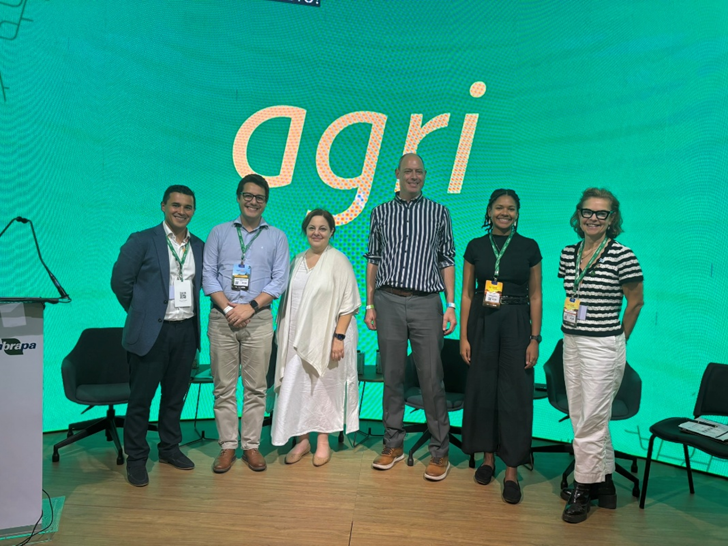
U.S. Grains & BioProducts Council (USGBC) Director of Global Sustainability Carlos Suárez (leftmost) and USGBC Multilateral Policy Manager Linda Schmid (rightmost) recently attended COP30, the United Nations' annual climate summit, to share the carbon-reduction benefits of biofuels.